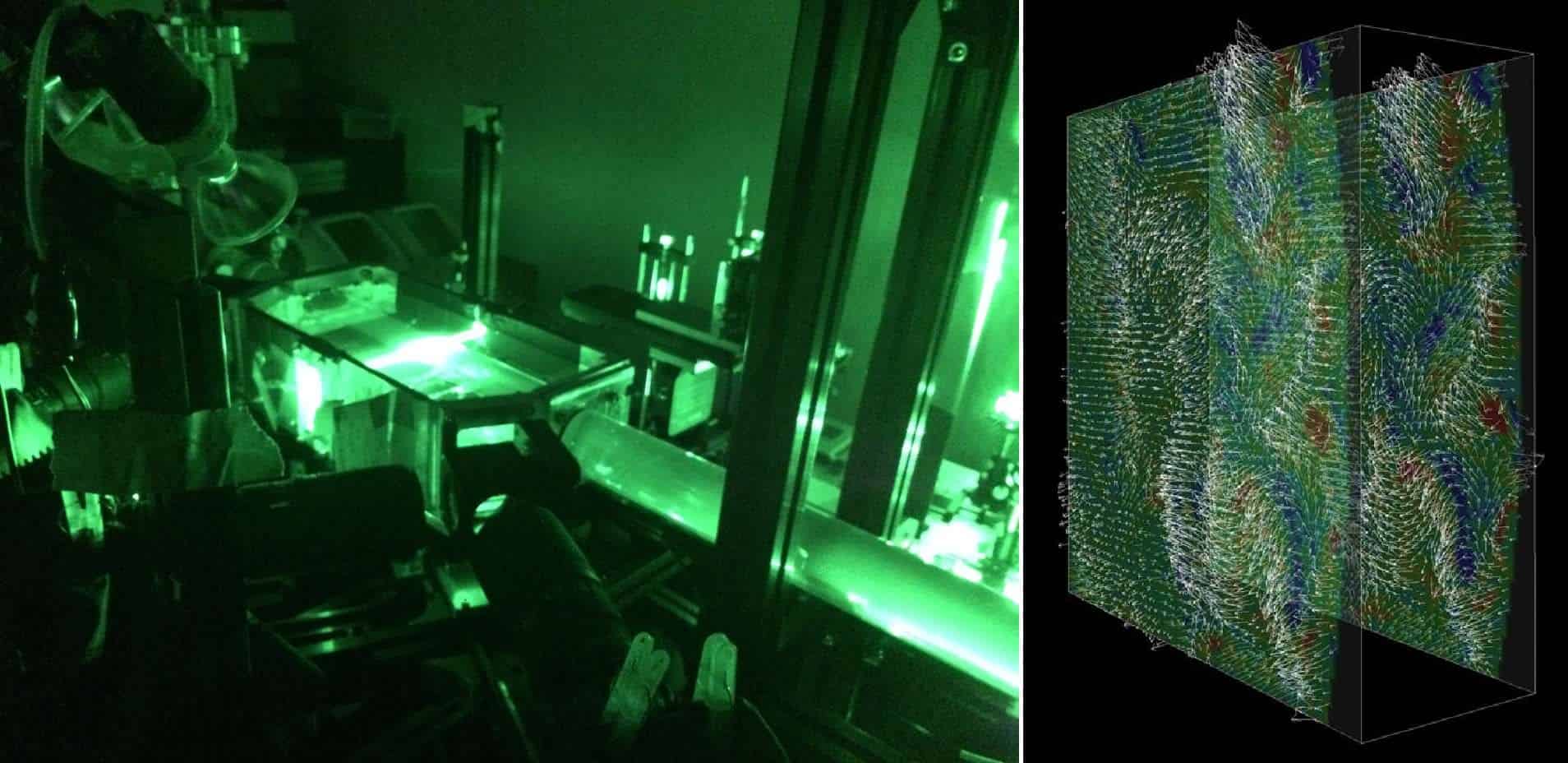
Traditionally, fluid velocity has been measured using contact-based devices such as Pitot tubes and hot-wire anemometers. These methods allow inexpensive and accurate measurement at a single point, but because the probe physically contacts the flow, it may disturb the flow field, and it is generally not possible to capture spatial velocity distributions. To overcome these limitations, we use Particle Image Velocimetry (PIV), a non-contact optical measurement technique that can capture the entire flow field. In PIV, extremely small tracer particles—on the order of the diameter of a human hair—are added to the flow. A high-energy-density laser sheet is then irradiated into a region of the flow (the measurement plane), and the scattered light from the tracer particles is recorded at very short time intervals. From each pair of particle images, the displacement of the particles is obtained through image processing, enabling the calculation of the velocity field throughout the measurement region.
Research on Turbulent Wall-Bounded Flows and Skin Friction Drag
1. What Is Turbulent Wall-Bounded Flow?
Turbulence has positive effects such as enhancing mixing, diffusion, and combustion. However, it also has negative aspects: in flows along pipes or walls, turbulence greatly increases resistance, known as skin friction drag. Especially today, as energy and environmental issues call for urgent action, the development of drag-reduction technologies—which contribute to improving the energy efficiency of transportation systems such as automobiles, ships, aircraft, and pipeline heat/mass transport—is critically important. In this research, we conduct laser-based measurements of turbulent pipe flow, a fundamental type of wall-bounded turbulence, with the aim of understanding the underlying physics and gaining insights that can lead to new drag-reduction technologies.
2. Measuring Turbulent Flows Using Lasers: Principles and Methods
3. PIV Results and Skin-Friction Drag Reduction
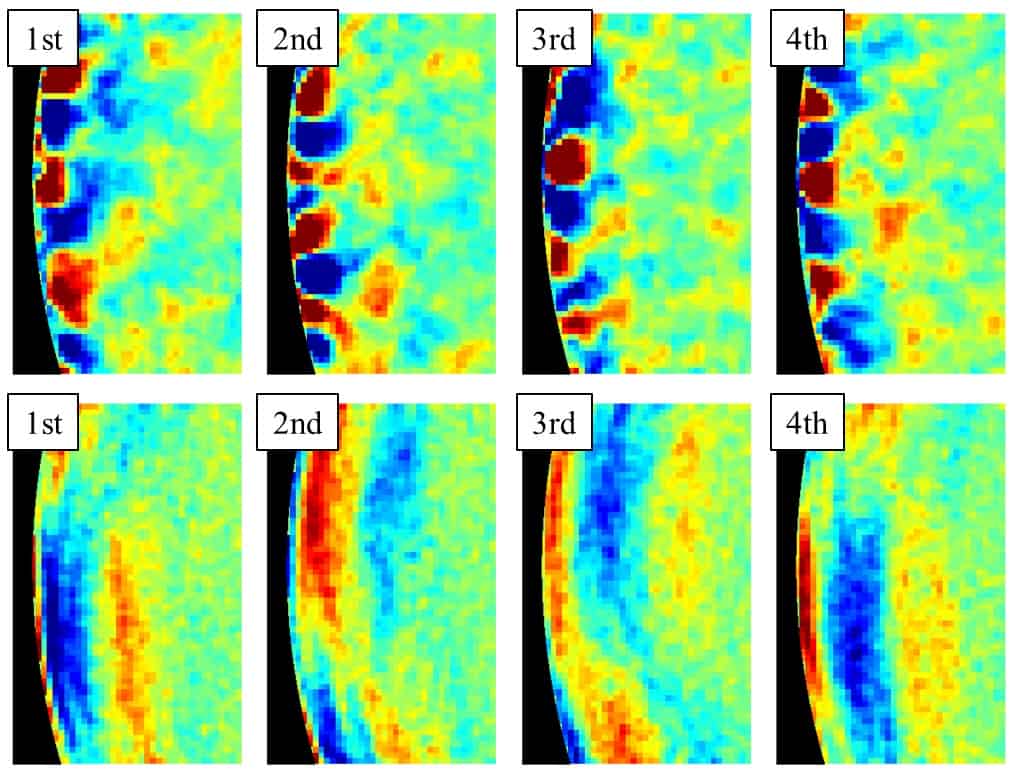
It is known that adding surfactants to a fluid can reduce skin friction drag—a phenomenon known as the Toms effect. Using a modal decomposition technique called Proper Orthogonal Decomposition (POD), we can extract dominant flow structures in both pure water and surfactant-added cases, enabling the investigation of how surfactants alter turbulent motions related to drag.